Affiliate Disclosure: This guide contains affiliate links. If you purchase through these links, we may earn an affiliate commission at no additional cost to you. All product specifications, DAC chipsets, power ratings, and network capabilities are verified against official manufacturer technical documentation.
Audiophile Streaming & Amplification Guide • 2026 Edition
Smart Hi-Fi Reimagined: The Definitive WiiM Audio Ecosystem Guide
How Linkplay’s WiiM hardware disrupted traditional high-end audio by delivering bit-perfect 192kHz/24-bit streaming, reference ESS and AKM DACs, Post-Filter Feedback (PFFB) amplification, and acoustic room calibration at accessible prices.
For decades, achieving audiophile-grade digital streaming required four-figure investments in standalone network transports, external ladder DACs, and complex multi-box component stacks. WiiM disrupted this landscape by engineering compact, highly optimized hardware platforms powered by the Linkplay audio engine. Today, WiiM offers everything from tiny, puck-sized Wi-Fi streamers to all-in-one Class-D streaming amplifiers and high-precision digital preamps with glass touchscreens.
However, choosing the right WiiM device requires matching the product’s core engineering to your existing equipment:
- Music Streamers (WiiM Mini, Pro, Pro Plus, Ultra): Act as digital audio bridges. They lack speaker amplifiers and are designed to send analog or digital signals into an existing stereo amplifier, AV receiver, powered monitor set, or external DAC.
- Streaming Amplifiers (WiiM Amp, Amp Pro, Amp Ultra): Combine a network streamer, an internal audiophile DAC, and a high-efficiency Class-D stereo power amplifier into one chassis. They connect directly to traditional passive bookshelf or floor-standing speakers.
- Wireless Ecosystem Hardware (WiiM Sub Pro, Sound, Sound Lite, Vibelink Amp): Expand your environment into true 2.1 high-resolution stereo, standalone wireless multi-room playback, or power-separated amplification.
Section 1: Start With Your Existing Audio Setup (Four Decision Paths)
Before selecting a specific model, identify what hardware already sits in your living room, office, or listening den. Choosing the correct WiiM product category prevents unnecessary redundancy and ensures immediate compatibility.
1. Upgrade an Existing Stereo
You own an integrated amplifier, vintage stereo receiver, or set of powered studio monitors that you love, but it lacks Wi-Fi, AirPlay, or app-based streaming.
Recommended: WiiM Ultra, Pro Plus, or Pro
Connects via RCA analog line out, optical Toslink, or coaxial SPDIF. Your existing amplifier continues driving the speakers.
2. Power Passive Speakers
You own a pair of unpowered bookshelf, architectural in-wall, or tower speakers (4Ω to 8Ω) and have no separate amplifier on your shelf.
Recommended: WiiM Amp or WiiM Amp Pro
Contains a built-in Class-D power amplifier (60W/ch @ 8Ω, 120W/ch @ 4Ω). Connect speaker wire directly to the gold-plated binding posts.
3. Build Multi-Room Audio
You want synchronized music throughout the kitchen, living room, and patio without running hundreds of feet of physical speaker cabling.
Recommended: Any Mixed WiiM Lineup
All WiiM devices communicate across your local Wi-Fi/Ethernet network via the WiiM Home App, offering sub-millisecond clock synchronization.
4. Improve TV & Media Sound
You want high-fidelity 2.0 or 2.1 stereo sound from your Smart TV with seamless volume control through your standard TV remote.
Recommended: WiiM Ultra, Amp Pro, or Amp
Features HDMI ARC (Audio Return Channel) with HDMI CEC support, turning your stereo into a streamlined TV sound center.
Section 2: Understand the WiiM Product Categories
WiiM’s catalog spans several distinct audio device types. Confusing a pure digital streamer with a streaming amplifier is the most common mistake buyers make. Here is how each category functions:
1. Dedicated Music Streamers & Preamplifiers (Mini, Pro, Pro Plus, Ultra)
These devices receive digital audio streams over your local network (via Wi-Fi or Ethernet) from services like Spotify, Tidal, Apple Music, Qobuz, Amazon Music, or your local NAS library. They convert the stream into pristine digital or analog signals:
- If you connect to an external DAC or digital receiver via Optical or Coaxial, the WiiM acts as a digital transport, passing bit-perfect 192kHz/24-bit PCM data.
- If you connect via RCA analog line out, the WiiM’s internal digital-to-analog converter (DAC) processes the audio. The quality of this internal DAC separates entry models from audiophile tiers.
- The WiiM Ultra advances this category further by integrating a physical volume knob, 3.5″ full-color touchscreen, dedicated headphone amplifier, and a dedicated phono input for vinyl turntables.
2. Integrated Streaming Amplifiers (Amp, Amp Pro, Amp Ultra)
An integrated streaming amplifier merges three components into a single compact aluminum enclosure: a network streamer, an audiophile DAC, and a stereo Class-D power amplifier. You do not need an external receiver or separate amp. You simply plug the unit into electrical power, run speaker wire to your passive speakers, and stream directly from your phone, tablet, or television.
3. Dedicated Power Amplifiers (WiiM Vibelink Amp)
For audiophiles who prefer separating the digital preamplifier stage from the high-current analog power stage, dedicated power amplifiers provide clean wattage without onboard network streaming. Pairing a preamplifier streamer like the WiiM Ultra with a pure power amp like the Vibelink allows each component to optimize its electrical shielding and thermal dissipation independently.
4. Active Wireless Speakers & Subwoofers (WiiM Sound, Sound Lite, Sub Pro)
WiiM’s expanded wireless ecosystem introduces standalone active smart speakers equipped with RoomFit™ acoustic calibration, alongside the WiiM Sub Pro (an 8-inch, 250W Class-D wireless subwoofer). These components allow modular 2.1 stereo setups and future multi-channel surround sound configurations without routing physical subwoofer interconnect cables across your floorboards.
| Category | Primary Function | Built-in Speaker Amp? | Required Downstream Gear | Representative Models |
|---|---|---|---|---|
| Music Streamers | Add high-res Wi-Fi/Ethernet streaming to existing audio gear | No | Stereo amplifier, AV receiver, or powered monitors | WiiM Mini, Pro, Pro Plus |
| Digital Preamps | Multi-input audio hub (phono, HDMI ARC, USB, streaming, display) | No | Power amp, integrated amp, or powered speakers | WiiM Ultra |
| Streaming Amplifiers | All-in-one streaming, DAC, and speaker power amplification | Yes (60W–120W) | Passive speakers (bookshelf or floor-standing) | WiiM Amp, WiiM Amp Pro |
| Power Amplifiers | High-current, low-distortion clean speaker drive | Yes (PFFB Class-D) | Preamplifier / Streamer (e.g., WiiM Ultra) + Speakers | WiiM Vibelink Amp |
| Wireless Subwoofers | Dedicated low-frequency acoustic bass extension | Yes (250W Class-D) | WiiM Amp, Amp Pro, Ultra, or Sound via Wi-Fi/Sub In | WiiM Sub Pro |
| Wireless Smart Speakers | Standalone acoustic music playback with multi-room sync | Yes (Acoustic Drivers) | None (Self-contained standalone playback) | WiiM Sound, WiiM Sound Lite |
Section 3: Featured WiiM Products — In-Depth Model Spotlights
Below, we examine the primary hardware choices in the WiiM lineup based on verified technical documentation, architectural teardowns, and practical setup compatibility.
1. WiiM Ultra — Flagship Music Streamer & Digital Preamplifier
Product Overview:
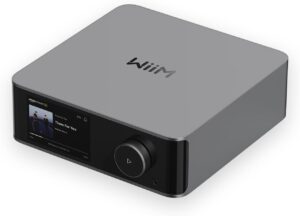
The WiiM Ultra represents the pinnacle of WiiM’s digital preamplifier engineering. Housed in a rigid aluminum unibody enclosure with an analog volume/navigation dial and an eye-catching 3.5″ full-color glass touchscreen, the Ultra is built to serve as the master control center for high-fidelity audio systems. It features an audiophile-grade ESS Sabre ES9038Q2M 32-bit/384kHz DAC, achieving a class-leading 121 dB Signal-to-Noise Ratio (SNR) and ultra-low -116 dB Total Harmonic Distortion (THD+N).
Beyond digital streaming, the Ultra solves multiple analog dilemmas. It includes a dedicated Phono input with ground post (supporting both Moving Magnet and high-output Moving Coil cartridges), an HDMI ARC port with CEC for TV audio, a dedicated high-current Texas Instruments TPA6120A2 front headphone amplifier, and a dedicated Subwoofer Output featuring customizable high-pass and low-pass bass management.
| Internal DAC / ADC | ESS Sabre ES9038Q2M (32-bit/384kHz) | TI Burr-Brown PCM1861 ADC (110 dB SNR) |
| Audio Performance | SNR: 121 dB (A-wt) | THD+N: -116 dB (0.00018%) | Headphone SNR: 119 dB |
| Audio Inputs | HDMI ARC, Phono (MM/MC with GND), Analog RCA Line-In, Optical Toslink, USB Media |
| Audio Outputs | Analog RCA Line-Out, Coaxial SPDIF, Optical Toslink, USB Audio Out, Subwoofer Out, 3.5mm Headphone |
| Network & Bluetooth | Wi-Fi 6E (Tri-band 2.4/5/6 GHz), Gigabit Ethernet, Bluetooth 5.3 with 2-way transmission |
| Acoustic Calibration | Built-in RoomFit™ automatic room correction, 10-band Graphic EQ, 10-band Parametric EQ |
| Streaming Ecosystem | Google Cast, Spotify Connect, TIDAL Connect (Hi-Res), Roon Ready, DLNA, Amazon Music, Alexa Cast |
Buying Recommendation: If you desire a physical touchscreen, front headphone jack, turntable phono stage, and TV HDMI ARC in a single digital preamplifier, the WiiM Ultra is the most capable streamer in the lineup.
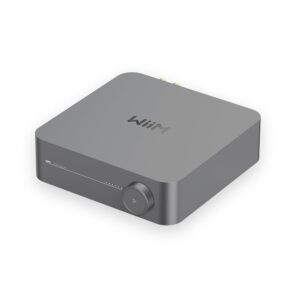
2. WiiM Amp Pro — Flagship Integrated Streaming Amplifier
Product Overview:
The WiiM Amp Pro represents an audiophile-focused evolution of the celebrated WiiM Amp. Designed to power passive bookshelf and floor-standing speakers directly, the Amp Pro retains the sleek aluminum footprint of its predecessor but introduces substantial internal acoustic upgrades. Most notably, its Texas Instruments TPA3255 Class-D power stage incorporates Post-Filter Feedback (PFFB) technology.
In conventional Class-D amplifiers, high-frequency response can vary depending on whether the connected speaker presents a 4-ohm or 8-ohm load. PFFB samples the signal after the output filter inductor, eliminating load dependency to deliver a ruler-flat frequency response, dramatically lower distortion (THD+N down to -105 dB at 5W), and an elevated 120 dB SNR via an upgraded ESS Sabre ES9038Q2M DAC. With tri-band Wi-Fi 6E, Bluetooth 5.3, HDMI ARC, and advanced RoomFit™ calibration, it provides an uncompromised one-box audio solution.
| Amplifier Power Rating | 60 Watts/channel into 8 ohms | 120 Watts/channel into 4 ohms (TI TPA3255 with PFFB) |
| Speaker Impedance | 4 ohms to 8 ohms supported with load-independent frequency response |
| Internal DAC Chip | ESS Sabre ES9038Q2M (SNR: 120 dB | THD+N: -105 dB / 0.0005%) |
| Audio Inputs | HDMI ARC (with CEC), Optical Toslink, Analog RCA Line-In, USB Media Storage |
| Audio Outputs | Gold-plated 5-way speaker binding posts, Dedicated Subwoofer Out, USB Audio Out |
| Network Connectivity | Wi-Fi 6E (Tri-Band), 100M Ethernet RJ45, Bluetooth 5.3 (Sink & Source) |
| Equalization & Tuning | RoomFit™ Acoustic Calibration, 10-band Graphic EQ, 10-band Parametric EQ, Sub Crossover |
Buying Recommendation: If you are buying a combined amplifier and streamer for your passive speakers, the Amp Pro’s PFFB distortion control and ESS 9038 DAC make it the superior long-term acoustic investment over the base Amp.
3. WiiM Amp — Mainstream Integrated Streaming Amplifier
Product Overview:
The standard WiiM Amp is the groundbreaking device that made high-performance streaming amplification affordable. Built into a compact, precision-crafted aluminum chassis with a front volume knob/status LED, it combines a Texas Instruments TPA3255 Class-D power stage with an ESS Sabre ES9018K2M DAC. Like its Pro sibling, it delivers a robust 60W per channel into 8 ohms and 120W per channel into 4 ohms.
What makes the standard WiiM Amp especially popular for multi-room home integrators and casual listeners is its broad protocol compatibility, including AirPlay 2 receiver support, Google Cast, Spotify/Tidal Connect, and Alexa Cast. With HDMI ARC for instant TV volume syncing, an optical input, RCA line input, and dedicated subwoofer output, it easily transforms any pair of passive speakers into a modern sound system.
| Amplifier Power Rating | 60 Watts/channel into 8 ohms | 120 Watts/channel into 4 ohms (TI TPA3255) |
| Internal DAC Chip | ESS Sabre ES9018K2M (SNR: 98 dB | THD+N: 0.002%) |
| Audio Inputs | HDMI ARC (CEC enabled), Optical Toslink, Analog RCA Line-In, USB Host |
| Audio Outputs | Stereo Speaker Binding Posts (Banana plug compatible), Subwoofer Out (30–200Hz crossover) |
| Wireless Connectivity | Wi-Fi 5 (Dual-band 802.11 b/g/n/ac), 100M Ethernet, Bluetooth 5.0 |
| Streaming Protocols | AirPlay 2, Google Cast, Spotify Connect, TIDAL Connect, Roon Ready, DLNA |
| Sound Tailoring | Room Correction, 10-band Graphic EQ, 10-band Parametric EQ, 26 EQ Presets |
Buying Recommendation: If you want an affordable, all-in-one streaming amplifier with native AirPlay 2 support and reliable power for standard 8-ohm speakers, the WiiM Amp remains an extraordinary bargain.
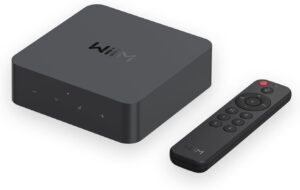
4. WiiM Pro Plus — Audiophile Network Streamer with AKM DAC
Product Overview:
The WiiM Pro Plus is engineered specifically for listeners who plan to connect a network streamer to an existing amplifier using standard analog RCA cables. While the standard WiiM Pro uses a basic Texas Instruments DAC chip, the Pro Plus upgrades the entire analog output and input boards. It integrates AKM’s acclaimed AK4493SEQ Velvet Sound™ 32-bit/768kHz DAC alongside ultra-low-noise operational amplifiers.
This hardware upgrade yields a measured Line-Out Signal-to-Noise Ratio of 121 dB and THD+N of -113 dB, rivaling standalone dedicated DACs costing hundreds of dollars more. Furthermore, it incorporates a Texas Instruments Burr-Brown PCM1861 ADC on its line-in stage, allowing you to digitize analog sources (like a vinyl preamp or cassette deck) at 192kHz/24-bit for multi-room transmission. With AirPlay 2, Google Cast, Roon Ready certification, and an included WiiM Voice Remote, it is the purist’s streaming bridge.
| Internal DAC / ADC | AKM AK4493SEQ Velvet Sound DAC | TI Burr-Brown PCM1861 ADC (110 dB SNR) |
| Analog Output SNR & THD | SNR: 121 dB (A-wt) | THD+N: -113 dB (0.00023%) across all sample rates |
| Audio Inputs | Analog RCA Line-In (Up to 2Vrms), Optical Toslink (Up to 192kHz/24-bit) |
| Audio Outputs | Analog RCA Line-Out, Coaxial SPDIF, Optical Toslink (Bit-perfect up to 192k/24-bit) |
| Network & Streaming | Dual-band Wi-Fi, 100M Ethernet, Bluetooth 5.1 BLE, AirPlay 2, Google Cast, Roon Ready |
| Trigger & Remote | 12V Trigger Out (Auto-wakes compatible amplifiers), WiiM Voice Remote included |
Buying Recommendation: If your receiver or amplifier relies on analog RCA inputs, the WiiM Pro Plus delivers a massive, audible jump in clarity, dynamics, and noise floor over the base Pro and Mini.
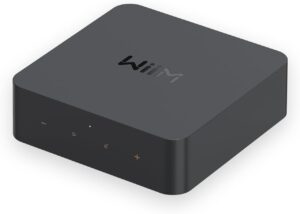
5. WiiM Pro — Versatile Workhorse Network Streamer & Digital Transport
Product Overview:
The WiiM Pro is the modern Swiss Army knife of audio streaming. Sharing the exact same quad-core processor, memory architecture, physical I/O layout, and software capabilities as the Pro Plus, the standard Pro uses a Texas Instruments PCM5121 DAC. While its internal analog RCA output is decent (106 dB SNR), the Pro shines brightest as a pure digital streaming transport.
When connected via Optical or Coaxial SPDIF to an external DAC, modern AV receiver, or powered digital speakers, the WiiM Pro transmits bit-perfect 192kHz/24-bit audio without altering the digital bitstream. It supports Ethernet for rock-solid network stability, full AirPlay 2 receiver capabilities, Google Cast Audio, Roon Ready endpoint certification, TIDAL Connect with Hi-Res FLAC, and a 12V trigger to automatically turn on your amplifier when playback begins.
| Digital Transport Output | Bit-perfect Coaxial SPDIF and Optical Toslink (Up to 192kHz / 24-bit, unresampled) |
| Internal DAC Chip | Texas Instruments PCM5121 (SNR: 106 dB | THD+N: -92 dB) |
| Audio Inputs | Analog RCA Line-In, Optical Toslink input |
| Audio Outputs | Analog RCA Line-Out, Coaxial SPDIF, Optical Toslink |
| Wired & Wireless Network | 100M Ethernet RJ45, Dual-band Wi-Fi (802.11 b/g/n/ac), Bluetooth 5.1 |
| Integration & Automation | 12V Trigger Out, Works with Alexa, Google Assistant, and Siri, WiiM Home App |
Buying Recommendation: If you plan to route your audio digitally into an existing DAC or AV receiver, save money and buy the WiiM Pro—you get all the flagship streaming software at a fraction of the cost.
6. WiiM Mini — Ultra-Compact Puck-Sized Audio Streamer
Product Overview:
The WiiM Mini is the device that launched WiiM’s reputation as an audio giant-killer. Weighing less than 50 grams and measuring just 69mm in diameter, this hockey-puck-shaped streamer packs serious digital capability into an ultra-portable footprint. Powered by a standard USB-C cable (5V, 1A), it fits discretely behind vintage receivers, desktop amplifiers, or bedside sound systems.
Despite its tiny dimensions and budget price, the Mini features an Optical SPDIF output capable of delivering bit-perfect 192kHz/24-bit digital audio. It fully supports AirPlay 2, Spotify Connect, TIDAL Connect, and gapless playback. For secondary zones, garage workshops, or travelers wanting to stream to hotel stereos, the Mini is an unbeatable audio upgrade.
| Dimensions & Weight | 69 × 69 × 24 mm (2.7″ × 2.7″ × 0.9″) | 40g (1.4 oz) |
| Digital Output Resolution | Bit-perfect Optical Toslink up to 192kHz / 24-bit lossless |
| Audio Connections | 3.5mm Analog Aux In, 3.5mm Analog Aux Out (2Vrms), Optical SPDIF Out |
| Wireless Connectivity | Dual-band Wi-Fi (802.11 a/b/g/n/ac), Bluetooth 5.0 (Receiver & Transmitter) |
| Power Requirement | USB Type-C (5V, 1A power supply or standard USB port) |
| Supported Protocols | AirPlay 2, Spotify Connect, TIDAL Connect, DLNA, Alexa Multi-Room, WiiM Multi-Room |
Buying Recommendation: If you need an ultra-compact, budget-friendly Wi-Fi streamer with bit-perfect Optical output and native AirPlay 2 support, the WiiM Mini is the undisputed category benchmark.
7. WiiM Ecosystem Expansion: Sub Pro, Sound, Sound Lite & Vibelink Amp
Ecosystem Overview:
WiiM’s roadmap extends far beyond standalone desktop streamers. The expanding ecosystem addresses multi-channel immersion, wireless low-frequency extension, and discrete power stages:
- WiiM Sub Pro: A wireless active smart subwoofer featuring an 8-inch driver powered by a 250W Class-D amplifier. With built-in Wi-Fi 6E and RoomFit™ acoustic calibration, it pairs wirelessly with the WiiM Amp, Amp Pro, or Ultra, automatically offloading sub-bass frequencies below your chosen crossover point (e.g., 80Hz) to relieve your primary speakers and amplify dynamic headroom.
- WiiM Sound & Sound Lite: Standalone active smart speakers engineered with custom acoustic drivers (treated paper-cone woofers, silk-dome tweeters) and onboard streaming intelligence. They can be deployed as standalone kitchen/bedroom audio or paired as a matched stereo pair with RoomFit™ auto-tuning.
- WiiM Vibelink Amp: A dedicated, high-performance stereo power amplifier utilizing the Texas Instruments TPA3255 chipset with Post-Filter Feedback (PFFB). Stripping away the digital streaming computer, it focuses purely on high-current, low-noise amplification, making it the companion power stage for the WiiM Ultra.
- WiiM Bar: A streamlined soundbar engineered to anchor TV and home theater setups, bringing the WiiM streaming OS and multi-room ecosystem directly beneath your screen.
Section 4: Master WiiM Device Comparison
Use this verified specification table to compare the core hardware differences across the primary WiiM models:
| Model | Category | Amplification | DAC Architecture | Key Inputs & Outputs | Standout Feature | Best For | Options |
|---|---|---|---|---|---|---|---|
| WiiM Ultra | Digital Preamp | None (Line Level) | ESS Sabre ES9038Q2M (121 dB SNR) | HDMI ARC, Phono MM/MC, Line Out, Coax, Optical, Sub Out, Headphone | 3.5″ Color Touchscreen & Phono Preamp | Central hi-fi hub, vinyl, TV, and headphone lovers | View → |
| WiiM Amp Pro | Streaming Amp | 60W/8Ω, 120W/4Ω (PFFB) | ESS Sabre ES9038Q2M (120 dB SNR) | HDMI ARC, Line In, Optical In, Speaker Binding Posts, Sub Out | PFFB Load-Independence & Wi-Fi 6E | High-resolution playback with 4Ω or 8Ω passive speakers | View → |
| WiiM Amp | Streaming Amp | 60W/8Ω, 120W/4Ω | ESS Sabre ES9018K2M (98 dB SNR) | HDMI ARC, Line In, Optical In, Speaker Binding Posts, Sub Out | Integrated Class-D Amp + AirPlay 2 | All-in-one TV and bookshelf speaker power | View → |
| WiiM Pro Plus | Pure Streamer | None (Line Level) | AKM AK4493SEQ (121 dB SNR) | RCA Line In/Out, Optical In/Out, Coaxial Out, 12V Trigger | Reference Velvet Sound DAC on RCA Out | Analog connection to vintage receivers or integrated amps | View → |
| WiiM Pro | Pure Streamer | None (Line Level) | TI PCM5121 (106 dB SNR) | RCA Line In/Out, Optical In/Out, Coaxial Out, Ethernet, 12V Trigger | Affordable Bit-Perfect Digital Transport | Feeding existing external DACs or digital receivers | View → |
| WiiM Mini | Puck Streamer | None (Line Level) | TI PCM5121 (102 dB SNR) | 3.5mm Aux In/Out, Optical Toslink Out, USB-C Power | Puck Form Factor & Bit-Perfect Optical | Secondary audio zones, desktop setups, budget streaming | View → |
Section 5: Deep Dive: WiiM Amp vs. WiiM Amp Pro vs. WiiM Amp Ultra
The streaming amplifier lineup often confuses prospective buyers because all models can power passive speakers and include HDMI ARC. However, their internal architectures address distinctly different listener priorities:
| Specification / Feature | WiiM Amp (Base) | WiiM Amp Pro | WiiM Amp Ultra (Flagship) |
|---|---|---|---|
| Power Output (8 Ohms) | 60 Watts / channel | 60 Watts / channel | 100 Watts / channel |
| Power Output (4 Ohms) | 120 Watts / channel | 120 Watts / channel | 200 Watts / channel |
| Amplifier Circuit Topology | Standard TI TPA3255 Class-D | TI TPA3255 with PFFB Feedback | High-Power Class-D with PFFB Feedback |
| DAC Architecture | ESS Sabre ES9018K2M | ESS Sabre ES9038Q2M | ESS Sabre ES9038Q2M (Flagship tuning) |
| THD+N at 5W | 0.002% (-94 dB) | 0.0005% (-105 dB) | 0.0004% (-108 dB) |
| Wi-Fi Generation | Wi-Fi 5 (2.4 / 5 GHz) | Wi-Fi 6E (2.4 / 5 / 6 GHz) | Wi-Fi 6E (2.4 / 5 / 6 GHz) |
| Bluetooth Version | Bluetooth 5.0 | Bluetooth 5.3 (2-Way) | Bluetooth 5.3 (2-Way) |
| Physical Display | Status LED only | Status LED only | 3.5″ Color Glass Touchscreen |
| AirPlay 2 Receiver | Supported | Not Supported (Google Cast) | Not Supported (Google Cast) |
Understanding Post-Filter Feedback (PFFB) in Plain English
All Class-D amplifiers use an LC (inductor-capacitor) output filter to remove high-frequency switching noise before sending audio to your speaker terminals. In budget Class-D designs without feedback after this filter (like the standard WiiM Amp), the amplifier’s frequency response interacts directly with the speaker’s impedance:
- If your speakers drop to 4 ohms or lower in the upper treble, the high frequencies may sound slightly attenuated or dull.
- If your speakers rise to 8 or 16 ohms in the treble, the frequency curve can tilt upwards, producing an overly bright or fatiguing sound signature.
PFFB solves this: By sampling the audio after the filter and feeding an error correction signal back into the circuit, the WiiM Amp Pro and Amp Ultra maintain a ruler-flat frequency response regardless of what speaker impedance curve is connected. If you own high-end bookshelf or tower speakers with complex impedance dips, the Amp Pro ensures pristine tonal accuracy.
Section 6: Deep Dive: WiiM Mini vs. Pro vs. Pro Plus vs. Ultra
For music lovers who already own an amplifier or active speakers, choosing among WiiM’s four pure streamers comes down to inputs, outputs, DAC performance, and protocol support:
| Feature | WiiM Mini | WiiM Pro | WiiM Pro Plus | WiiM Ultra |
|---|---|---|---|---|
| Form Factor | Round Plastic Puck | Square Matte Black | Square Matte Black | Aluminum Unibody + Screen |
| Internal DAC | TI PCM5121 | TI PCM5121 | AKM AK4493SEQ | ESS Sabre ES9038Q2M |
| Line Out SNR | 102 dB | 106 dB | 121 dB | 121 dB |
| Analog Line-In ADC | Basic 48kHz ADC | Basic TI ADC | TI Burr-Brown PCM1861 | TI Burr-Brown PCM1861 |
| Turntable Phono Input | No | No | No | Yes (MM/MC with Ground) |
| HDMI ARC (TV) | No | No | No | Yes (HDMI ARC with CEC) |
| Headphone Output | Shared 3.5mm Aux | No (Line Out only) | No (Line Out only) | Dedicated TPA6120A2 Jack |
| Digital Outputs | Optical only | Optical + Coaxial | Optical + Coaxial | Optical + Coaxial + USB Audio |
| Subwoofer Output | No | No | No | Yes (with Bass Management) |
| Ethernet Port | No (Wi-Fi only) | Yes (100M RJ45) | Yes (100M RJ45) | Yes (Gigabit RJ45) |
| Roon Ready & Cast | No | Yes | Yes | Yes |
| AirPlay 2 Receiver | Yes | Yes | Yes | No (Uses Google Cast / Connect) |
The Critical DAC Decision: Analog RCA vs. Digital Output
If your plan is to use a digital connection (Optical or Coaxial) into an external DAC or digital home theater receiver, your receiver handles the digital-to-analog conversion. In that configuration:
- The WiiM Pro delivers the exact same bit-perfect 192kHz/24-bit digital stream as the more expensive Pro Plus.
- However, if you plan to plug directly into the analog RCA inputs of a vintage receiver or integrated amp, the WiiM Pro Plus and WiiM Ultra are drastically superior, eliminating jitter, noise floor, and harmonic distortion.
Section 7: Build the Right WiiM System (Practical Scenarios)
Goal: Add wireless Spotify, Tidal Hi-Res, and high-resolution streaming to a classic 1970s or 1980s stereo receiver (Marantz, Pioneer, Sansui, Yamaha).
Best Choice: WiiM Pro Plus (or WiiM Ultra if turntable integration is needed).
- Connect the WiiM Pro Plus analog RCA Line Out to the AUX, Tape In, or Tuner RCA inputs on your vintage receiver.
- In the WiiM Home App, set the Line Out level to Fixed Volume (2Vrms) so your vintage receiver’s volume knob acts as the master preamplifier without dual-gain distortion.
- Enjoy audiophile-grade AKM Velvet Sound conversion that honors the warmth of your vintage receiver.
Goal: Drive a pair of modern passive speakers (e.g., KEF Q150, ELAC Debut 2.0, Polk R200, Klipsch RP-600M) without buying a large stack amplifier.
Best Choice: WiiM Amp Pro (or WiiM Amp).
- Run standard 14-gauge or 16-gauge speaker wire from the binding posts directly to your speakers.
- Connect the HDMI ARC port to your smart television for seamless TV audio with automatic CEC volume control.
- Run RoomFit™ in the WiiM Home App using your smartphone microphone to calibrate acoustic room peaks.
Goal: Combine an analog turntable, television, high-res streaming, and audiophile headphones into a single desktop or living room system.
Best Choice: WiiM Ultra paired with a power amp or powered monitors.
- Connect your turntable RCA cables and ground wire directly to the Ultra’s dedicated Phono MM/MC stage.
- Connect your television via HDMI ARC.
- Plug your favorite planar or dynamic headphones directly into the front 3.5mm jack.
- Stream audio wirelessly from your turntable to other WiiM devices in different rooms across your home network.
Goal: Play synchronized party music across four zones (living room, patio, kitchen, master bedroom) or play different sources in each room simultaneously.
Best Choice: Mixed WiiM Ecosystem (e.g., Amp Pro in living room, Amp on patio, Pro Plus on office stereo, Mini in bedroom).
- Group all devices in the WiiM Home App with a single swipe.
- Sub-millisecond audio clock synchronization prevents echo or phase cancellation between adjoining rooms.
- Adjust zone volumes individually or link master volume across the entire house.
Section 8: Core Audio Technologies Explained in Plain English
To get the most out of your audio equipment, it helps to understand the engineering terms highlighted in WiiM specifications:
1. High-Resolution Audio & Bit-Perfect Playback
Standard CD quality is 44.1kHz at 16 bits. High-resolution audio streams provide sample rates up to 192kHz at 24 bits, containing significantly more acoustic data, dynamic range, and ambient decay. “Bit-perfect” playback means the streaming hardware passes this digital audio stream to the DAC chip without internally resampling, truncating bits, or altering digital volume, preserving the original studio recording.
2. Signal-to-Noise Ratio (SNR) and Dynamic Range
SNR measures the difference in decibels (dB) between the musical signal and the unwanted electrical noise floor. An SNR of 106 dB (found in the WiiM Pro) is very good for everyday listening, but an SNR of 121 dB (found in the Pro Plus and Ultra) ensures absolute, inky-black silence during musical pauses, even when connected to high-sensitivity horn speakers or low-noise amplifiers.
3. RoomFit™ Acoustic Auto-Calibration & Parametric EQ
Every room acts as an acoustic filter. Parallel walls create standing waves (room modes) that can cause bass frequencies around 50Hz–120Hz to sound boomy, bloated, or muddy. WiiM’s RoomFit™ uses your smartphone or tablet microphone to measure frequency response at your listening position, automatically applying corrective parametric equalization filters to smooth out room resonance without muddying vocal clarity.
4. Bass Management & Active Subwoofer Integration
WiiM products equipped with a Subwoofer Out (WiiM Amp, Amp Pro, Ultra, and Sub Pro) feature true digital crossover filtering. When you set a sub crossover at 80Hz, the device routes frequencies below 80Hz to the subwoofer and applies a high-pass filter to send frequencies above 80Hz to your primary speakers. This relieves your bookshelf speakers and amplifier from producing power-hungry deep bass, allowing them to play cleaner with greater dynamic punch.
Section 9: Setup, Compatibility & Common Pitfalls Checklist
Before finalizing your purchase and setting up your equipment, review these essential audio configuration guidelines:
- Check Speaker Type (Passive vs. Active): If your speakers have their own power cord that plugs into a wall outlet, they are active/powered; use a streamer (Mini, Pro, Pro Plus, Ultra). If your speakers only connect via bare speaker wire, they are passive; you need a streaming amplifier (Amp or Amp Pro).
- The Dual-Volume Knob Trap: When connecting a WiiM streamer (Pro, Pro Plus, Ultra) to an existing integrated amplifier or stereo receiver via RCA, go to Audio Output Settings in the WiiM Home App and switch volume from Variable to Fixed Line Out. This bypasses the digital software volume and delivers maximum dynamic range straight to your receiver’s analog preamp.
- TV PCM Audio Format: When connecting via HDMI ARC or Optical from your Smart TV, enter your TV’s Audio Settings and switch the digital output format from “Auto” or “Dolby Digital Bitstream” to PCM Stereo. WiiM streamers are dedicated two-channel stereo devices; raw multi-channel Dolby/DTS bitstreams will produce audible clicking, stuttering, or silence.
- Network Stability for 192kHz/24-bit: High-res audio streams require consistent local bandwidth. While dual-band Wi-Fi is robust, connecting via Ethernet cable (available on Pro, Pro Plus, Amp, Amp Pro, and Ultra) guarantees zero buffering or dropouts when streaming high-bitrate FLAC or multi-room audio.
- Phono Ground Connection on WiiM Ultra: When connecting a vinyl turntable to the WiiM Ultra’s phono input, always secure your turntable’s ground wire to the knurled GND terminal on the Ultra’s rear panel to prevent 60Hz electrical mains hum.
Section 10: Is WiiM Right for You? A Balanced Assessment
While WiiM hardware has earned universal acclaim among audio reviewers and enthusiasts, no single audio platform fits every conceivable setup. Here is an honest appraisal of the platform’s strengths and considerations:
Where WiiM Excels
- Software Reliability & Rapid Updates: Unlike legacy hi-fi companies whose proprietary streaming apps are often clunky and rarely updated, WiiM issues bi-weekly firmware updates, continually adding features (such as Parametric EQ and RoomFit™) to older models at zero cost.
- Unbeatable Value: A WiiM streamer paired with an affordable modern DAC or amplifier routinely outperforms multi-thousand-dollar legacy streamers in measured distortion, noise floor, and protocol flexibility.
- Format Agility: Supports Spotify Connect, TIDAL Connect (Hi-Res FLAC), Google Cast, Qobuz, Amazon Music Ultra HD, DLNA, and Roon Ready without forcing you into a single proprietary ecosystem.
Considerations to Keep in Mind
- AirPlay 2 on Newer Hardware: While the WiiM Mini, Pro, Pro Plus, and base Amp support AirPlay 2 receiver functionality, the newer flagship hardware (WiiM Ultra and Amp Pro) omits AirPlay 2 due to Apple’s updated hardware licensing requirements. Apple users still stream effortlessly via Spotify Connect, Tidal Connect, or Bluetooth, but whole-house AirPlay 2 grouping from Apple devices requires the earlier models.
- Home Theater Expansion: WiiM systems excel at 2.0 and 2.1 stereo audio. If you demand native Dolby Atmos decoding with 7.1.4 physical ceiling speaker channels, a dedicated multi-channel AV surround processor is still required.
Section 11: Frequently Asked Questions (WiiM Audio FAQ)
Section 12: Final Buying Recommendations
To select your ideal WiiM audio component, match your existing hardware to these clear buying paths:
- To power passive speakers with zero clutter and audiophile fidelity: Choose the WiiM Amp Pro for its distortion-free PFFB Class-D power stage, ESS 9038 DAC, and Wi-Fi 6E.
- To create a master hi-fi hub with a touchscreen, vinyl phono input, and TV HDMI ARC: Choose the WiiM Ultra to feed your power amp, vintage receiver, or active monitors.
- To revitalize an existing stereo receiver using analog RCA cables: Choose the WiiM Pro Plus for its exceptional AKM Velvet Sound DAC and ultra-low noise floor.
- To feed an existing high-end external DAC or digital home theater receiver: Choose the WiiM Pro as an affordable, rock-solid bit-perfect digital transport with Ethernet.
- To add high-res streaming to a compact desk, bedroom, or secondary zone on a budget: Choose the ultra-compact WiiM Mini.
Explore Verified WiiM Streamers, Amplifiers & Packages
Review current device availability, bundle packages, voice remotes, and official specifications directly on the official store: