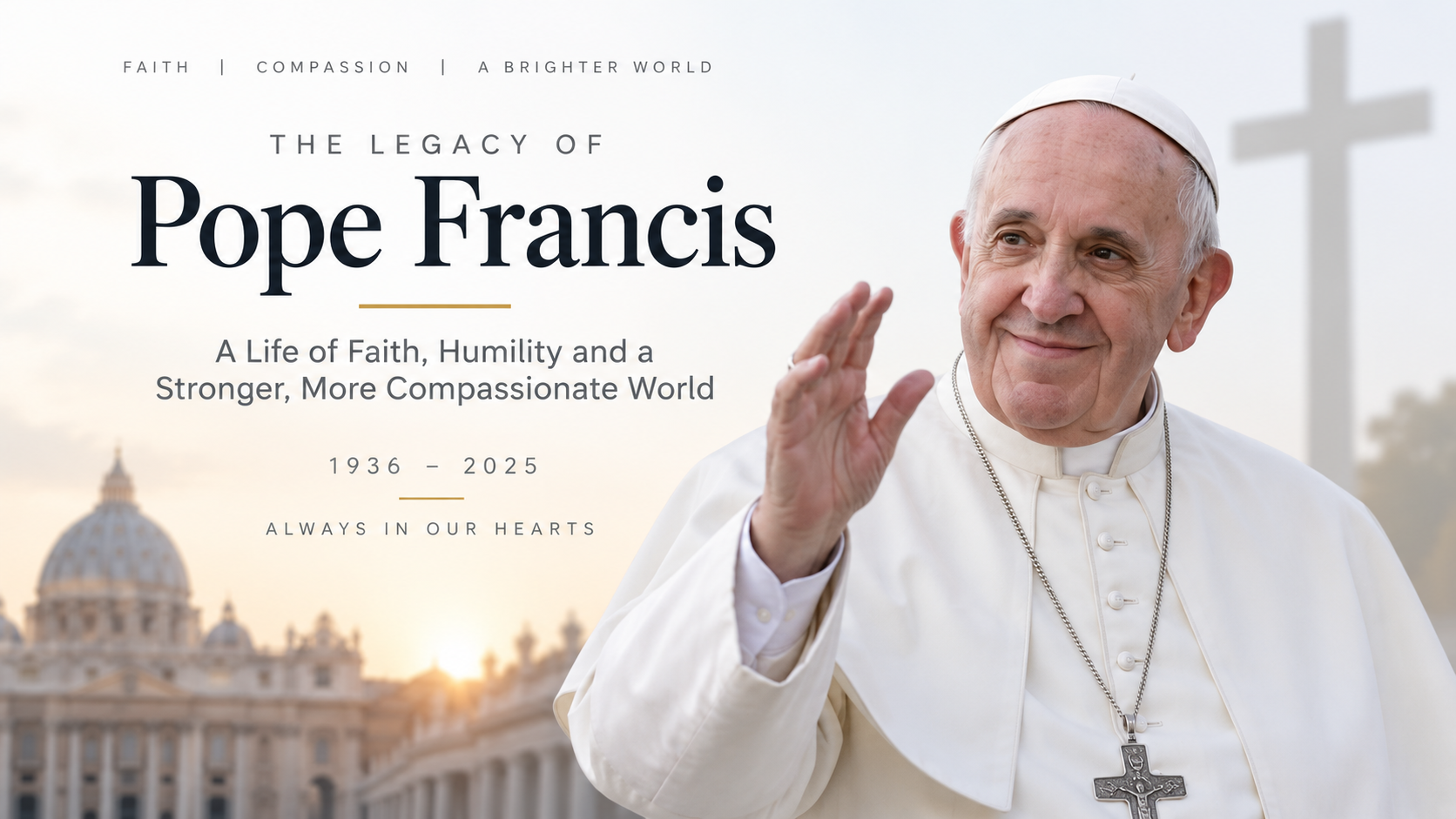
Introduction: The Passing of a Global Spiritual Leader
In a moment that has brought profound sorrow to millions around the world, the Catholic Christian religious leader, Pope Francis, has died at the age of 88. According to official statements released by the Vatican, the Pope took his last breath at 7:35 am on the 21st of April. As the first Latin American Pope in history, his departure marks the end of a deeply transformative and historic era for the Catholic Church. The solemn announcement was made by Cardinal Kevin Farrell, Camerlengo of the Holy Roman Church, who addressed the faithful at 9:45 AM. With deep emotion, he stated, “Dearest brothers and sisters, with deep sorrow I must announce the death of our Holy Father Francis. At 7:35 this morning, the Bishop of Rome, Francis, returned to the house of the Father.” This news has rippled across the globe, touching the hearts of the faithful and global citizens alike who admired his message of humility, peace, and boundless compassion.
Who Was Pope Francis? The Journey of the People’s Pope
Pope Francis was affectionately known worldwide as the ‘People’s Pope.’ This title was not merely ceremonial; it was a profound reflection of his enduring commitment to the poor, the marginalized, and the forgotten. Born Jorge Mario Bergoglio in Buenos Aires, Argentina, his ascension to the papacy shattered centuries of tradition. He was the first person to become Pope from Latin America, a monumental shift that brought the vibrant and dynamic faith of the Global South to the forefront of the Catholic Church. Before his election, there had been no non-European bishop to hold the office in Rome since the death of the Syrian-born Gregory III in the year 741. Furthermore, he was the first Jesuit to ever be elected to the throne of St. Peter, bringing with him the Jesuit traditions of intellectual rigor, social justice, and deep spiritual discernment.
His legacy as Pope spanned more than a decade, a period characterized by a relentless drive to modernize the Church’s pastoral approach while remaining rooted in its core teachings. Pope Francis was a figure of immense warmth, known for his spontaneous gestures of kindness, his willingness to embrace those suffering from illness and poverty, and his consistent plea for a more merciful and inclusive Church. Over the years, his influence extended far beyond the walls of the Vatican. He became a moral compass for a world grappling with complex challenges, from economic inequality and environmental degradation to global conflicts and the plight of refugees.
A Historic Tenure: Records, Reforms, and Milestones
Former Argentine Cardinal Jorge Mario Bergoglio officially became the first pope to adopt the name Francis upon his election on March 13, 2013. The choice of the name Francis was highly symbolic, paying homage to St. Francis of Assisi, the legendary friar known for his devotion to peace, nature, and the poor. By choosing this name, he set the tone for his entire pontificate. He became the 266th pope in the long and storied history of the Catholic Church. His tenure as the Bishop of Rome lasted an impressive 12 years and 1 month, a period significantly longer than the average tenure of 7.5 years observed across his 265 predecessors. His long reign allowed him to implement sweeping reforms and leave an indelible mark on the Church’s structure and pastoral focus.
Throughout his papacy, Pope Francis reached several notable milestones. He became the second-oldest pope in the recorded history of the Church, a testament to his enduring stamina and unwavering dedication to his calling despite the physical challenges of advancing age. For context, the longest-serving pope in terms of age was Pope Leo XIII, who died in 1903 at the remarkable age of 93. Despite facing various health issues in his later years, Pope Francis continued to lead with vigor, refusing to let physical limitations hinder his spiritual mission. His resilience inspired many, demonstrating a profound commitment to his duties until the very end of his life.
Reshaping the College of Cardinals
One of the most significant and lasting impacts of Pope Francis’s papacy will undoubtedly be his profound influence on the College of Cardinals. During his 12-year tenure, Pope Francis appointed an astonishing 109 cardinals, significantly reshaping the demographic and geographic makeup of the body responsible for electing his successor. As of now, these appointed cardinals are among those eligible to vote for the next pope. Currently, 135 of the 252 living cardinals—often referred to as the ‘princes of the church’ and distinguished by their iconic red hats—are under the age of 80. According to ancient Church law, only cardinals under 80 are eligible to enter the papal conclave and cast a vote in the election of a new pope.
These eligible voters, known as cardinal electors, represent a more diverse and globally representative Church than ever before. Pope Francis deliberately looked beyond traditional European strongholds, appointing cardinals from marginalized communities, developing nations, and regions where the Catholic Church is growing rapidly. This strategic shift ensures that the next conclave will reflect a broader array of perspectives and experiences. In addition to their crucial role in electing the next pontiff, these cardinals serve as key advisors to the pope during his term, often leading powerful departments within the complex Vatican bureaucracy. Their influence will be felt for generations, carrying forward the inclusive vision that Pope Francis so passionately championed.
A Global Pilgrim: Pope Francis’s Extensive Travels
Pope Francis was a pope in constant motion, a true global pilgrim who traveled far and wide to spread his message of peace, dialogue, and compassion. Recognizing that the modern papacy requires an active presence on the world stage, he made international pastoral visits a cornerstone of his ministry. Over the course of his pontificate, he traveled outside of Italy an incredible 47 times. During these apostolic journeys, he visited more than 65 countries, touching down on almost every continent and reaching out to diverse cultures and communities. Remarkably, his travels meant he visited about a third of all the countries globally, an unprecedented feat that underscores his commitment to universal outreach.
His international travels were not merely diplomatic missions; they were deeply spiritual encounters. He visited war-torn nations to plead for peace, impoverished regions to highlight the need for economic justice, and secular societies to engage in dialogue about faith and human dignity. In total, his journeys covered more than 465,000 kilometers over 12 years—a staggering distance that demonstrates his boundless energy and dedication. Whether addressing millions of faithful in open-air masses, meeting with political leaders, or washing the feet of prisoners, Pope Francis used his travels to physically embody the Church’s message of love and solidarity, leaving a lasting impression on everyone he encountered.
The Path Forward: Who Will Be the Next Pope?
With the passing of Pope Francis, the Catholic Church now enters a period of transition and deep reflection as it prepares to elect his successor. A papal conclave, the highly secretive and deeply traditional process of electing a new pope, typically begins 15 to 20 days after a pope’s death. This period allows cardinals from around the world to gather in Rome and engage in preliminary discussions, known as the General Congregations. The pope is elected according to centuries-old Vatican traditions that have withstood the test of time, blending strict protocols with deep spiritual solemnity.
When the conclave officially begins, the College of Cardinals who are under the age of 80 will gather and vote in absolute secret inside the breathtakingly beautiful Sistine Chapel, beneath the masterful frescoes of Michelangelo. The process is rigorous and requires a strong consensus; a two-thirds majority is necessary to elect a new pope. The world will watch closely for the iconic white smoke rising from the Sistine Chapel’s chimney, signaling that a decision has been made.
Speculation is already mounting regarding who might succeed the historic papacy of Francis. A few prominent names have emerged at the forefront of discussions. Among the most frequently mentioned successors are Luis Antonio Tagle of the Philippines, a charismatic leader representing the dynamic Asian Church; Pietro Parolin of Italy, a seasoned diplomat and the current Secretary of State; Peter Turkson of Ghana, a strong voice for social justice from Africa; Peter Erdo of Hungary, a respected canon lawyer; and Angelo Scola of Italy, a prominent intellectual. Whoever the next pope may be, he will inherit a Church that has been profoundly shaped by the vision, humility, and enduring love of Pope Francis.
The Legacy of Humility and Environmental Advocacy
Beyond his institutional reforms and global travels, Pope Francis will be remembered for his powerful encyclicals and his unwavering advocacy for the environment. His landmark encyclical, Laudato si’, was a clarion call for the protection of the planet and a profound critique of consumerism and irresponsible development. He coined the term ‘integral ecology,’ arguing that environmental degradation and social injustice are inextricably linked. By urging humanity to care for our ‘common home,’ he elevated environmental concerns to the level of moral and spiritual imperatives, inspiring climate activists, scientists, and political leaders worldwide.
His emphasis on humility was evident in his daily life. From his decision to reside in the modest Casa Santa Marta rather than the opulent Apostolic Palace, to his use of a simple Ford Focus instead of a luxurious papal limousine, Pope Francis lived the message he preached. He consistently challenged the clericalism within the Church, urging priests and bishops to be ‘shepherds living with the smell of the sheep.’ This approach endeared him to millions, breaking down the barriers between the hierarchy and the laity. His legacy is one of profound humanity, reminding the world that true leadership is rooted in service, empathy, and a deep, abiding love for all creation.
A Vision for a Synodal Church
In his later years, Pope Francis championed the concept of a ‘synodal’ Church—a Church that listens, dialogues, and discerns together. He initiated a global consultation process, inviting Catholics from all walks of life to share their hopes, concerns, and experiences. This ambitious synodal process aimed to foster a more participatory and inclusive Church, where the voices of women, laypeople, and marginalized groups are actively heard and valued. By emphasizing journeying together, he sought to move the Church away from a top-down, authoritarian model toward a more collaborative and communal expression of faith.
This commitment to synodality represents a fundamental shift in the Church’s internal culture. It is a messy, complex, and sometimes controversial process, yet Pope Francis believed it was essential for the Church’s survival and relevance in the modern world. He envisioned a Church that is a ‘field hospital’ after battle, prioritizing healing and accompanying people in their struggles over enforcing rigid rules. As the Catholic world mourns his passing, the seeds of synodality he planted will undoubtedly continue to grow, shaping the future trajectory of the Church for decades to come.
Moreover, his vision extended far beyond the immediate theological disputes of his day. He possessed a profound understanding of the historical moment in which he lived, recognizing the profound shifts occurring in global geopolitics and culture. He saw a world deeply fractured by inequality and ideological division, and he sought to position the Church as a bridge-builder, a mediator in conflicts, and a voice for the voiceless. His diplomatic efforts were not always successful, but his willingness to engage with adversaries—whether political leaders, leaders of other faiths, or marginalized groups—demonstrated a courageous commitment to dialogue.
His economic teachings also resonated deeply with a world still recovering from global financial crises and grappling with the realities of globalization. He consistently criticized unbridled capitalism, arguing that an economic system prioritizing profit over human dignity is inherently flawed. He called for an ‘economy of inclusion,’ where the needs of the poorest are prioritized and the resources of the earth are shared equitably. This economic vision, rooted in Catholic social teaching, provided a powerful counter-narrative to the prevailing economic orthodoxies of our time, challenging individuals and nations alike to rethink their priorities and embrace a more solidarity-based approach to development.
As we look to the future, the challenge for the Church will be to integrate the profound lessons of his papacy while navigating the ongoing complexities of a rapidly changing world. The reforms he initiated, particularly his efforts to increase transparency and accountability within the Vatican bureaucracy, remain a work in progress. His successors will inherit the monumental task of continuing this critical work, ensuring that the institution remains faithful to its core mission while responding effectively to the needs of the contemporary world.
His impact on the spiritual lives of millions of individuals is perhaps his most enduring legacy. Through his homilies, his encyclicals, and his simple, profound gestures of compassion, he touched the hearts of countless people, offering them a vision of a God who is endlessly merciful and loving. He reminded a world often characterized by cynicism and despair that hope is a powerful, transformative force, capable of overcoming the deepest divisions and the darkest moments of human history. His words and actions will continue to resonate for years to come, offering guidance, inspiration, and a profound sense of spiritual comfort to a world in need.
Furthermore, his papacy profoundly reshaped the global perception of the Catholic Church. Before his election, the Church had often been viewed, particularly in the secular West, as an out-of-touch institution, struggling to address contemporary moral and social issues. Pope Francis, with his charismatic personality and his willingness to address difficult topics head-on, injected a new vitality and relevance into the Church’s public discourse. He demonstrated that faith and reason are not mutually exclusive, and that a deep spiritual commitment can and must be accompanied by a profound engagement with the pressing challenges of our time.
The impact of his legacy will be studied by historians and theologians for decades. His unique blend of Ignatian spirituality, Latin American pastoral experience, and global vision created a papacy unlike any other in modern history. He was a pope of surprises, a leader who constantly challenged expectations and pushed the boundaries of traditional ecclesiastical norms. His willingness to embrace vulnerability, to acknowledge his own shortcomings, and to ask for forgiveness when necessary, modeled a form of leadership that was both profoundly human and deeply inspiring.
Conclusion
The death of Pope Francis marks the end of a remarkable chapter in human history. He was a beacon of hope in troubled times, a voice for the voiceless, and a tireless advocate for peace. His legacy will be debated, celebrated, and studied for generations. But for the millions who loved him, he will always be remembered simply as a good and faithful servant, a true pastor who walked alongside his flock with grace, humor, and an unshakeable faith in the boundless mercy of God. As the world mourns his passing, we also celebrate a life dedicated entirely to the service of others, a life that has left an indelible mark on the Church and the world. His message of love, compassion, and unwavering commitment to the poorest among us will continue to echo through the ages, reminding us all of the profound power of faith and the enduring importance of human solidarity.