
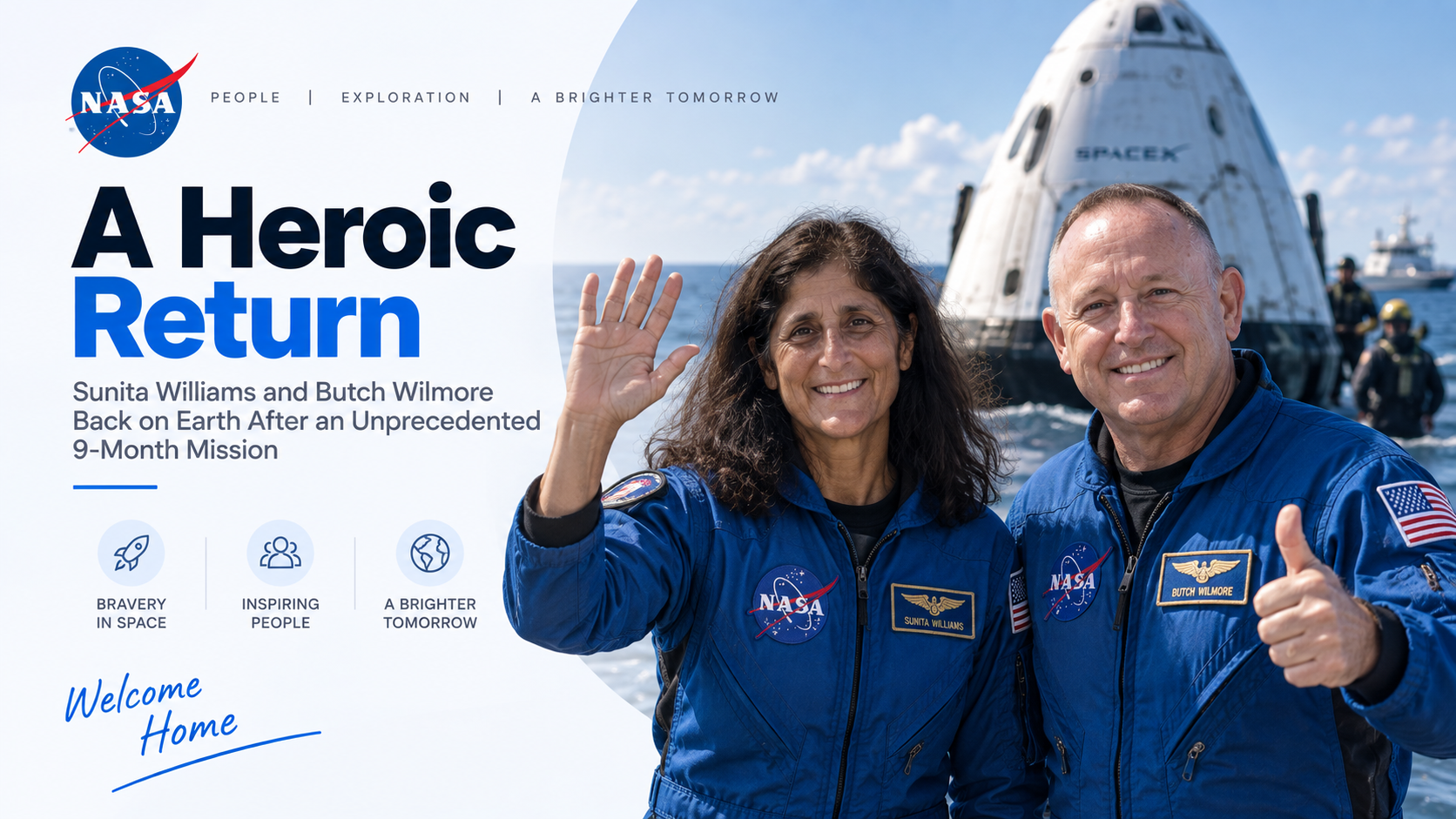
Introduction: A Historic Homecoming
In what will be remembered as one of the most remarkable stories of space exploration, NASA astronauts Sunita Williams and Butch Wilmore have finally returned to Earth. Touching down after an unexpected nine-month stay aboard the International Space Station (ISS), the veteran space explorers were welcomed back as global heroes. The journey, initially planned as a brief week-long mission, evolved into an incredible saga of endurance, technical troubleshooting, and international cooperation.
Their safe return aboard a SpaceX Dragon spacecraft marks the end of a grueling chapter that had the world watching with bated breath. The spacecraft splashed down off the Florida coast at 3:27 pm IST on a Wednesday, ending a mission that stretched far beyond its original scope. As they transition back to gravity, their story stands as a testament to the unyielding human spirit and the dedication of teams on the ground who worked tirelessly to bring them home safely.
The Thrilling Return and Splashdown
The anticipated return of Williams and Wilmore was a meticulously planned 17-hour flight back to our home planet. Transitioning from the microgravity environment of the ISS to Earth’s atmosphere is always perilous, but doing so after nine months adds profound complexity. The descent required pinpoint accuracy and flawless communication.
Descending through the atmosphere, the SpaceX Dragon capsule deployed its parachutes seamlessly, creating a majestic visual as it drifted toward the ocean. When the capsule splashed down, cheers erupted in mission control rooms. The splashdown at 3:27 pm IST was more than just a successful landing; it was a profound sigh of relief for families and enthusiasts who had followed the dramatic twists of this mission.
Accompanying Williams and Wilmore on this return journey were fellow NASA astronaut Nick Hague and Russian cosmonaut Alexander Gorbunov. Together, this diverse crew navigated the final leg of an extraordinary mission. The recovery teams moved swiftly to secure the capsule, ensuring that their first moments back on Earth were handled with utmost medical precision.
From a Week-Long Test to a Nine-Month Odyssey
To appreciate the magnitude of this return, we must look back at the origins of the mission. In June 2024, Williams and Wilmore launched with a specific objective: to test the Boeing Starliner capsule. The program was intended to provide NASA with an alternative method for transporting astronauts.
The plan was straightforward: dock, conduct rigorous tests over a week, and return. However, space is unforgiving. Shortly after arriving at the ISS, engineers detected significant technical issues with the Starliner. Thruster malfunctions and helium leaks raised serious concerns about the spacecraft’s ability to safely navigate the journey back through Earth’s atmosphere.
Safety being paramount, NASA deemed the Starliner unsafe for the return trip. What was supposed to be a short sprint transformed into a long-duration marathon. Williams and Wilmore integrated themselves into the ISS crew, taking on new scientific experiments and maintenance duties. They spent nine months living and working in low Earth orbit, demonstrating extreme adaptability.
The Boeing Setback and the SpaceX Rescue
The failure of the Boeing Starliner triggered a monumental shift in mission planning. NASA had to devise an alternative strategy, turning to their trusted commercial partner, SpaceX. The situation underscored the sheer importance of having multiple reliable vehicles capable of human spaceflight. Without the redundancy provided by the SpaceX Crew Dragon, returning the stranded astronauts would have been exponentially more difficult.
The SpaceX Dragon was repurposed to serve as the ride home for Williams and Wilmore. This required extensive coordination between NASA, SpaceX, and international partners. The logistical reshuffling demonstrated the agility of the modern space program. When the new crew arrived at the station, it paved the way for the veteran astronauts to pack their bags for a much-delayed homecoming. This event highlights the vital necessity of having a robust, multifaceted approach to space access.
The Physical Toll: 45 Days of Rehabilitation
While the psychological resilience of Williams and Wilmore has been widely celebrated, the physical toll of their extended stay in space cannot be understated. When subjected to the microgravity environment of the ISS for nine months, physiological changes occur rapidly.
Despite rigorous daily exercise routines aboard the station using specialized equipment, astronauts inevitably experience a sharp loss of body mass, muscle density, and bone density. The cardiovascular system also adapts to not pumping blood against gravity, meaning that returning to Earth causes dizziness, weakness, and a profound sense of heaviness.
Because their stay was unexpectedly extended, Williams and Wilmore are facing a daunting 45-day rehabilitation period. This comprehensive medical protocol is designed to help their bodies re-adapt to life at 1G. A team of flight surgeons and physical therapists will closely monitor their progress. Their daily routines will involve a careful reintroduction to weight-bearing exercises and cardiovascular conditioning. This meticulous evaluation phase is crucial for their personal health.
A Global Wave of Celebration and Gratitude
The successful splashdown ignited a wave of celebration that transcended borders. The safe return of astronauts who had effectively been stranded in space captured the public’s imagination. The White House quickly issued a statement, framing the rescue as a triumph of American ingenuity.
“Promise made, promise kept,” the official White House statement declared. “President Trump pledged to rescue the astronauts stranded in space for nine months. Today, they safely splashed down in the Gulf of America, thanks to Elon Musk, SpaceX, and NASA!” This acknowledgment underscored the collaborative effort required to resolve the ongoing crisis.
Elon Musk, the visionary CEO of SpaceX, took to social media to express his relief and pride. “Congratulations to the @SpaceX and @NASA teams for another safe astronaut return!” Musk wrote. His succinct message reflected the immense pressure that the SpaceX teams operated under to ensure that their vehicle could flawlessly execute the critical return mission, proving the reliability of their systems.
India’s Unwavering Pride in a Daughter’s Return
While the return was celebrated globally, the emotional resonance was particularly profound in India. Sunita Williams, with her Indian heritage, has long been a source of immense pride. Her extended stay and dramatic return only amplified the affection felt by millions of Indians.
Prime Minister Narendra Modi expressed profound happiness over the successful return. He described the mission as a shining example of courage. On the social media platform X, he wrote: “Welcome back, #Crew9! The Earth missed you. Theirs has been a test of grit, courage and the boundless human spirit. Sunita Williams and the #Crew9 astronauts have once again shown us what perseverance truly means.”
PM Modi further stated, “Their unwavering determination in the face of the vast unknown will forever inspire millions. Space exploration is about pushing the limits of human potential, daring to dream, and having the courage to turn those dreams into reality. Sunita Williams, a trailblazer and an icon, has exemplified this spirit throughout her career. We are incredibly proud of all those who worked tirelessly to ensure their safe return.”
The sentiment was echoed by numerous prominent figures. Sudha Murthy beautifully summarized the nation’s emotion by saying, “A daughter has come home.” BJP MP Ravi Kishan added, “Welcome! India’s daughter is the pride of India… All the children studying space have a lot to learn from her.” Rajya Sabha MP Rekha Sharma also offered her best wishes, emphasizing the eagerness to host Williams once she recovers.
Conclusion: A Legacy of Resilience and Inspiration
The Bottom Line is that this successful homecoming of Sunita Williams and Butch Wilmore is far more than a logistical achievement for NASA; it is a monumental victory for the global space community. The sheer dedication and profound resilience they displayed in the face of challenging and ambiguous situations have cemented their hero status once again.
Their journey reminds us that space remains an inherently dangerous frontier, requiring constant vigilance, adaptability, and an unwavering commitment to safety. Yet, it highlights the extraordinary capabilities of the human race when we unite to solve complex problems. As Williams and Wilmore undergo their rehabilitation, their legacy continues to inspire countless young minds to look up at the stars and dream.
Whether you are looking for spicy and entertaining content or just want to read out some trendy stories, Funandflip brings all the news and updates right in one place. Explore our website for more engaging stories from the realms of space, science, and beyond!