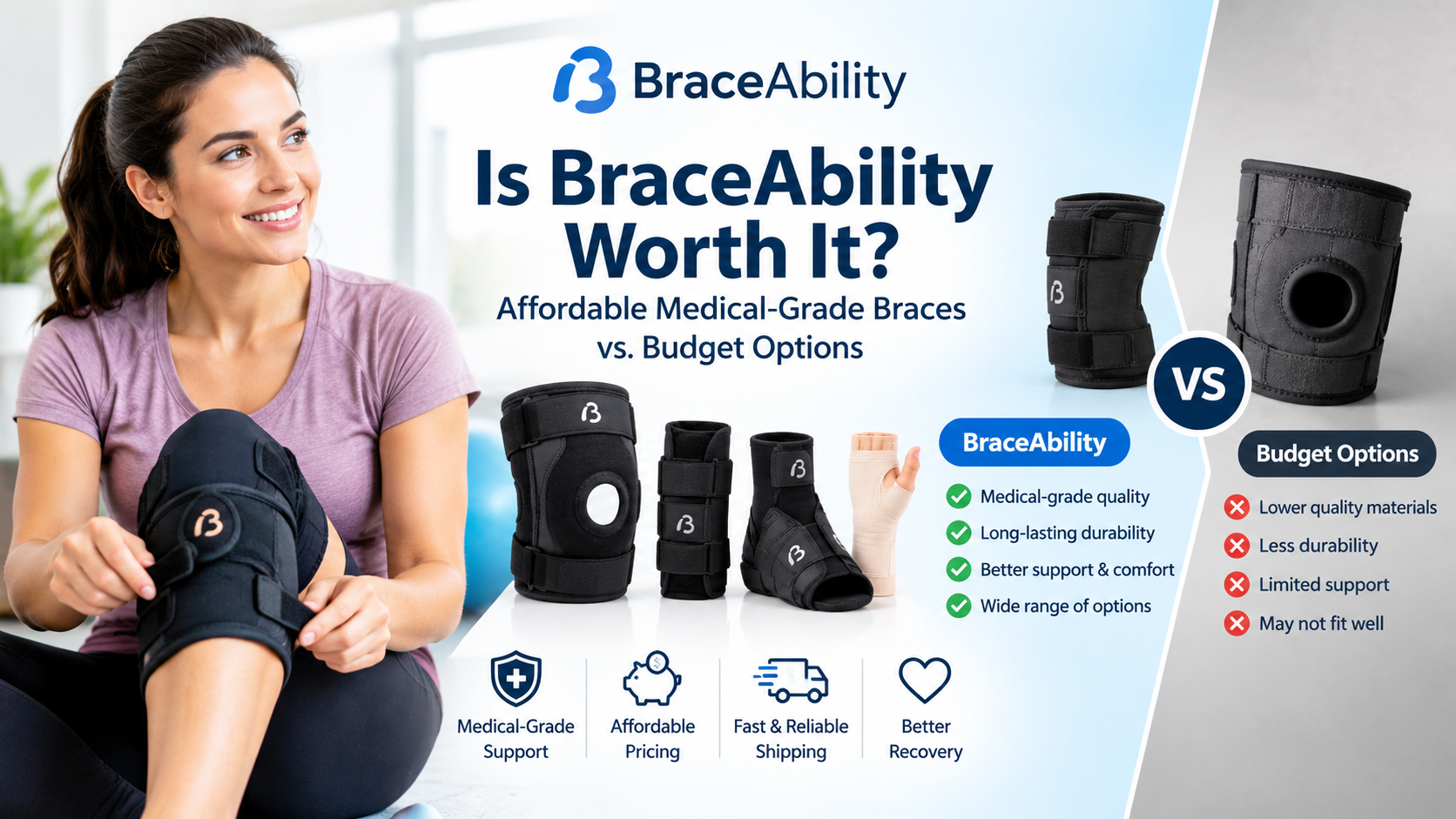
Introduction: The Unexpected Journey of Needing a Brace
Whether you enjoy it or not, anything requiring a brace suddenly turns your everyday life into a miniature, high-stakes project. One day you are going about your normal routine, and the next, you are forced into the frustrating world of measuring joints, deciphering complex medical labels, and trying to pick a brace that actually helps without completely draining your bank account. Navigating the world of orthopedic supports can be confusing, especially when you are already dealing with the stress of an injury.
If you have been seeking braces through online suppliers, you have almost certainly encountered BraceAbility. This prominent brand offers medical-grade braces that are aggressively priced, often sitting significantly lower than what you would pay at a specialized clinic or through large medical suppliers. But the burning question remains: how do they stack up against the cheaper, generic options you can quickly grab from your neighborhood drugstore? Or conversely, how do they compare to custom braces prescribed by a specialist? In this comprehensive guide, we provide a simple, jargon-free breakdown to help you make an informed decision.
Decoding the Jargon: What Does “Medical-Grade” Actually Mean?
You see the term “medical-grade” slapped on packaging all the time, but what does it genuinely signify? Ultimately, “medical-grade” denotes the application of clinical expertise in the design and manufacturing process. It is not just a buzzword; it translates to better materials, meticulous consideration for accuracy regarding anatomical fit, and clinical input during the development phase.
A brace that embodies these characteristics is not miracle gear that will magically heal you overnight. However, it is exponentially more likely to do the work it claims to do—whether that is stabilizing a wobbly knee, compressing a swollen ankle, unloading weight from a joint, or guiding a limb safely. More importantly, a medical-grade product is designed to perform without falling apart after a few wears.
BraceAbility distinguishes itself by promoting braces that look, feel, and function like clinical products. Their designs incorporate reinforced straps for targeted compression, removable stays for adjustable rigidity, and complex hinges that mimic natural joint movement. Crucially, they move far beyond the “one-size-fits-most” approach that plagues the budget market. If you need consistent support for recovering from an injury, protecting a joint post-surgery, or managing chronic symptoms, these characteristics are non-negotiable. While a cheap elastic sleeve might offer minor warmth, it will never provide true structural management.
The Economics of Healing: Price vs. Value
BraceAbility’s primary selling point is providing a highly affordable yet clinically sound option. Their pricing typically occupies the sweet spot between cheap drugstore braces and the exorbitantly expensive products found at hospital suppliers. For a massive segment of the population, this price point is incredibly appealing. You gain access to a brace that functions like a premium clinical product, but at a price manageable for self-paying patients.
When you look at local budget options, you can usually find something suitable for short-term soreness, a mild overnight strain, or a situation where you simply need something in a hurry. They are inexpensive and get the job done for minor ailments. However, if you are experiencing a recurring issue, structural instability, or navigating strict physical therapy, opting for the budget route is a false economy. Cheap braces tend to stretch out rapidly and fail to provide necessary motion restrictions. You may end up buying three or four cheap braces, spending more than you would have on a high-quality product.
On the opposite end of the spectrum, custom braces fabricated by specialists will generally perform better than any off-the-shelf option, especially in complex orthopedic situations. The significant disadvantage is the exorbitant cost and lengthy wait times. BraceAbility’s medical-grade, off-the-shelf approach frequently serves as the ideal middle ground: drastically superior to cheap options, yet nowhere near as financially paralyzing as custom care.
BraceAbility vs. The Drugstore: Practical Differences You Will Notice
When you upgrade from a budget brace to a mid-tier, medical-grade option, the differences become immediately apparent in everyday use. Here is a breakdown of the practical distinctions you will experience:
1. Anatomical Fit and Sizing Options
BraceAbility provides multiple specific sizes and typically features detailed sizing guides that require you to measure your body accurately. This approach helps you avoid the dreaded “too loose to support, too tight to circulate blood” dilemma frequently encountered with “one-size-fits-all” sleeves. Local budget braces often offer zero sizing guidance and rely entirely on fabric stretch.
2. Structural Support and Biomechanics
Structured, reinforced straps, rigid stays, and mechanical hinges are where medical-grade braces truly prove their worth. With proper engineered support, your knee, wrist, or back is physically limited from moving into dangerous planes of motion. A simple neoprene sleeve provides superficial compression and warmth, offering virtually zero structural stability when you pivot or twist.
3. Material Durability and Longevity
If a brace is constructed from superior, medical-grade materials, it will survive the harsh realities of daily wear, heavy sweat, repeated machine washing, and high-use scenarios. Cheap braces are notorious for falling apart in a shockingly short amount of time. The velcro degrades, elastic snaps, and seams fray, especially if used during sports or heavy manual labor.
4. Customer Service and Return Policies
Ordering any wearable item online can be intimidating because you cannot try it on first. BraceAbility typically mitigates this risk by offering clear, transparent return policies, and consumer reports generally indicate their customer service is highly responsive. While local physical stores allow you to try on a budget brace before committing, their selection is incredibly limited. Having access to a massive catalog of specialized braces with a good return policy is a significant advantage.
Navigating Your Choices: When Should You Choose Which Option?
Making the right choice depends entirely on the severity of your condition, your recovery timeline, and your budget. Here is a straightforward guide to help you decide:
The Local Budget Option
If you are dealing with minor, temporary symptoms—such as a brief flare-up of tendonitis, a minor tweak from weekend gardening, or slight arthritis pain—a local budget brace or basic sleeve will likely suffice. They are highly convenient, cheap, and easily accessible when you need immediate relief for a day or two.
The Medical-Grade Off-The-Shelf Option (BraceAbility)
If you are actively recovering from a moderate-to-severe injury, following a rehabilitation program prescribed by a physical therapist, dealing with chronic joint instability, or requiring a specific level of mechanical support, a medical-grade off-the-shelf brace is undeniably the most cost-effective decision. You will benefit from superior function and precise sizing that actually aids recovery.
The Custom Orthotist Option
If your condition is highly complex—involving severe anatomical deformity, the need for microscopic precision in joint control, or a permanent, lifelong requirement for bracing—then bypassing off-the-shelf options entirely and consulting an orthotist for a custom-molded brace is your safest, albeit most expensive, route.
The Direct-to-Consumer Medical Device Landscape in 2026
As we navigate through 2026, the landscape of personal healthcare and direct-to-consumer medical devices has shifted dramatically. Consumers are more educated and empowered than ever before, demanding transparency, quality, and affordability. Brands that bridge the gap between clinical efficacy and consumer accessibility are thriving. The modern patient no longer has to settle for subpar drugstore supplies or bankrupt themselves at specialized medical boutiques. The rise of accessible, medical-grade e-commerce has democratized orthopedic care, allowing individuals to take control of their recovery journeys.
A Simple Framework for Your Decision
If you are still on the fence, ask yourself these three critical questions:
- Duration: Exactly how long will I need to wear this brace? (Days vs. Months)
- Necessity: How much mechanical support does my specific condition realistically require to heal properly?
- Expertise: Has my healthcare provider explicitly recommended a specific brand, mechanical feature, or type of brace?
If your recovery requires a brace for an extended period, or if your physical therapist insists on specific structural support, it is always in your best interest to invest a slightly higher amount upfront. Spending a bit more for a sturdy, reliable, medical-grade brace will ultimately save you money on replacements and accelerate your healing time.
Final Thoughts
Purchasing a brace to aid in your recovery should never feel like a shot in the dark or a gamble with your mobility. You fundamentally need something that will genuinely help your condition, fit your body anatomically, and last through the rigors of rehabilitation. BraceAbility successfully provides a highly reasonable and practical compromise. They offer a drastically more reliable and therapeutically effective product than a generic drugstore sleeve, while simultaneously ensuring the pricing remains accessible.
Furthermore, they present a viable alternative to ultra-expensive custom orthotic care for the vast majority of injuries that do not strictly require it. If you ever find yourself unsure, the best course of action is to consult a doctor or physical therapist, measure your body with precision, and choose the level of structural support your body truly demands to heal. In countless practical, real-world scenarios, spending just a few extra dollars for a proper, medical-grade brace pays monumental dividends. It ensures your injury is managed correctly, allowing you to move with confidence and drastically reducing your worry for the months ahead.
Explore the world of fashion, beauty, lifestyle, and entertainment with Funandflip – your daily dose of trendy tips, style inspiration, and everything fun, fabulous, and fresh in one place!